
Quick Summary
Automated gate sensor failures account for a major portion of driveway gate malfunctions, leaving properties unsecured and entrapment protection compromised. Ironworks Gate Co. delivers precision diagnostics, lens realignment, and full sensor replacements to keep photo eyes and underground loop detectors operating safely without hazardous terminal bypassing. Readers will learn the functional differences between leading gate safety technologies, how to identify common sensor faults, and how to access same-day repair services across Dallas.
Automatic Gate Sensors: Diagnostic Guide and Field Solutions
A driveway gate stuck open leaves a property exposed, while a gate that repeatedly reverses mid-cycle causes immediate frustration. According to Ironworks Gate Co., in automated entry systems, sensor faults account for a large percentage of sudden service calls. Understanding how these safety devices operate and why they fail helps maintain reliable access.
How Automatic Gate Safety Sensors Work
Automatic gate safety sensors protect vehicles and pedestrians from impact during gate operation. Systems combine optical beams, electromagnetic induction loops, and physical edge sensors to monitor the path of travel and communicate with the main control board.[3] See also Automatic Gate Repair | Call Now-10% Off | On-Site in 60 Minutes | Free Estimate.
Under safety standards such as UL 325, automated gates require monitored external entrapment protection devices. When an obstruction breaks the sensor signal or if a sensor loses power, the control circuit interrupts travel to stop or reverse the gate.[4]
Photo Eye Sensors vs. Ground Loop Detectors
Property owners often compare gate opener photo eye sensors with in-ground loop detectors. While both prevent a gate from hitting an obstacle, they rely on different technologies:
- Gate Opener Photo Eye Sensors: An electric gate safety beam consists of a transmitter sending a continuous infrared light beam across the driveway to a receiver (or a retro-reflective mirror). When an obstruction breaks this beam, the system signals the operator to stop or reverse the gate.
- Loop Detectors for Automatic Gates: An induction loop detector uses an insulated wire coil embedded beneath the driveway surface. The loop creates a magnetic field. When a metal mass passes overhead, the system registers a change in inductance. These loops function as safety reverse loops in the swing path or as free-exit triggers.
- Magnetic Gate Exit Wands: A magnetic wand acts as an alternative to an exit loop. Buried alongside the driveway, it detects changes in the magnetic field caused by moving steel, opening the gate automatically upon departure.
- Driveway Gate Motion Sensors: Overhead radar or microwave detectors detect moving traffic approaching an access point.
Common Causes of Gate Sensor Faults
Technicians at Ironworks Gate Co. note that standard gate sensor troubleshooting focuses on common issues such as dirty lenses, loose terminal wiring, internal obstructions, water intrusion, or power loss in wireless sensors. Physical misalignment between the transmitter and receiver also causes the system to detect an obstruction, resulting in the gate stopping or reversing unexpectedly.
How to Align Gate Photo Eye Sensors Properly
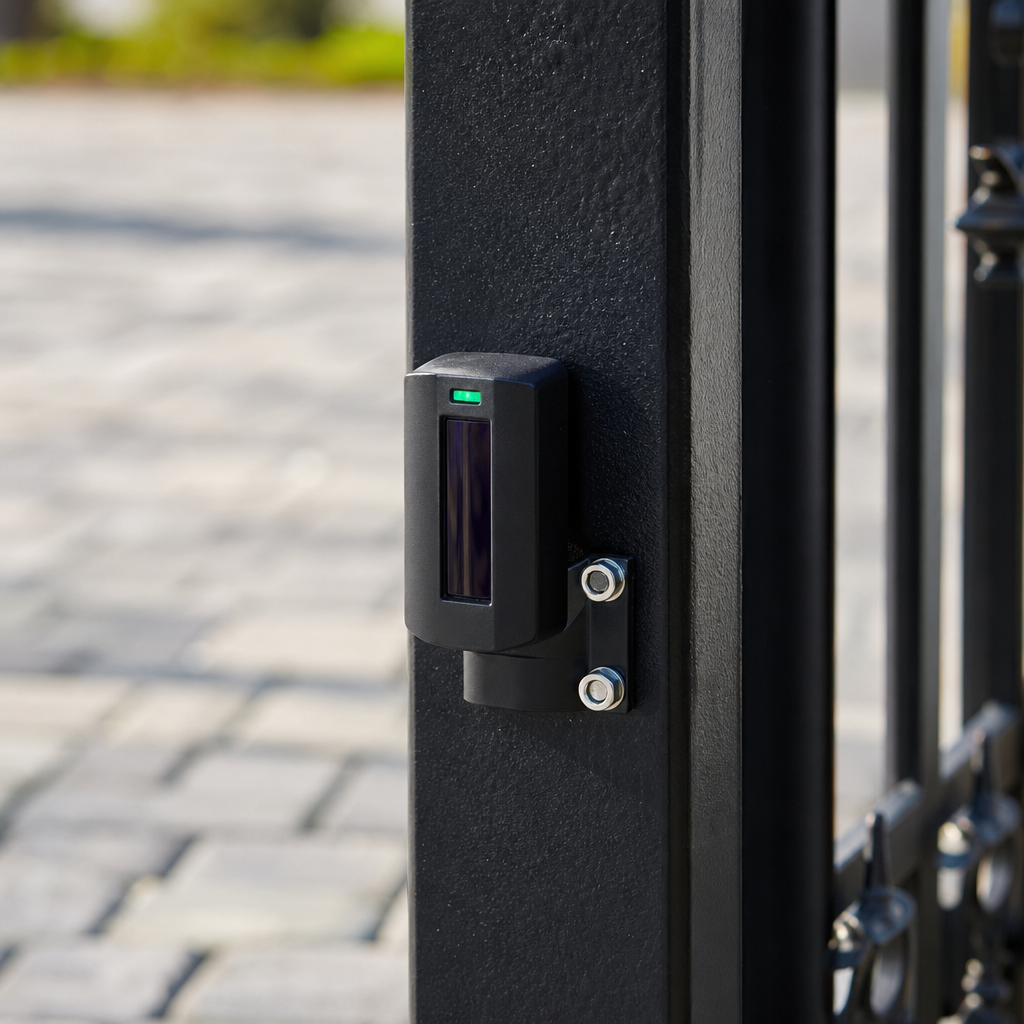
When an alignment fault is suspected, follow standard alignment practices:
- Clean the Optics: Wipe away dust, cobwebs, and debris from both the transmitter and receiver lenses using a soft cloth.
- Verify Mounting Height and Direct Aiming: Ensure that the transmitter and receiver are installed at matching heights and aimed directly across the driveway at one another.
- Test the Stop-or-Reverse Function: Confirm that photo-eye interruption stops or reverses the gate during operation as specified.
Safety Requirements and Sensor Bypassing
Failed safety sensors should not be bypassed. Bypassing a safety device creates a safety hazard and violates UL 325 safety standards. As Ironworks Gate Co. advises, if a safety sensor fails, the gate must not be operated with bypassed safety terminals. Instead, switch the operator to manual disconnect mode until proper repairs can be completed.
Sensor Industry Research and Emerging Technologies
Recent technological research explores sensing alternatives to address environmental vulnerabilities in optical and ultrasonic hardware. A 2025 academic study published in the Diva-Portal repository examined how standard ultrasonic sensors frequently struggle with environmental interference, testing millimeter-wave pulsed coherent radar for human-presence detection, gate timing, and cross-traffic filtering.[1]
The broader access control market continues to expand. The provided sources place the 2025 global access-control market at approximately USD 11.6 billion, with Fortune Business Insights reporting USD 11.62 billion and Verified Market Research reporting USD 11.66 billion. Hardware such as electronic readers, controllers, locks, and authentication devices held the largest market share in the 2025 analysis. According to SNS Insider, motion and presence sensors accounted for approximately 30.60 percent of the global accessing sensor market in 2025.[2]
Sources
- PRIVACY AND SECURITY – scholarshare.temple.edu
- Access Control Market Size, Share, Trends | Global Report, … – fortunebusinessinsights.com (2034)
- Accessing Sensor Market Size, Share & Growth, 2026-2035 – snsinsider.com (2035)
- Access Control Market Size & Share Analysis – mordorintelligence.com (2031)
Related reading: Electric Gate Stuck Open | Call Now-10% Off | On-Site in 60 Minutes | Free Estimate
Related reading: Driveway Gate Repair – Call Now-10% Off – On-Site in 60 Minutes – Free Estimate
Related reading: Automatic Gate Troubleshooting – 10% Off & Free Estimate – Same-Day Service
Frequently Asked Questions
How can I tell if my gate sensors need full replacement instead of simple realignment?
If cleaning the optics and re-aiming the housing fails to clear the fault indicator, internal component damage from moisture, pests, or electrical surges is usually the cause. Ironworks Gate Co. tests voltage thresholds and optical beam strength to determine whether realignment or a full sensor replacement is required.
Can damaged underground loop detectors be repaired without tearing up the driveway?
Yes, technicians first test the loop harness and detector module inside the control box to rule out simple board-level malfunctions before touching the driveway. If the embedded induction loop wire is physically severed, Ironworks Gate Co. can cut, lay, and seal a new precision loop directly into existing concrete or asphalt channels.
What immediate steps should I take if my gate sensors fail and leave the gate stuck open?
Switch the operator into manual release mode to secure your property safely instead of attempting to jump or bypass the sensor terminals, which violates UL 325 safety codes. You can then contact Ironworks Gate Co. for same-day dispatch to diagnose and resolve the sensor fault.
About the author
 |
Christopher Vance Christopher Vance brings over 12 years of hands-on experience in access control and automatic gate systems. Certified by the Institute of Door Dealer Education and Accreditation (IDEA), he specializes in troubleshooting complex gate operator issues and providing transparent cost assessments. Based in Texas, Christopher is dedicated to educating property owners on safe, reliable gate maintenance and repair. |
Gate not opening, off track, or opener dead?
We’re available now - call for a fast, free estimate.
Call Now - Free Estimate