
Quick Summary
When an automated driveway gate hums, stalls, or refuses to move, a degraded gate motor capacitor is frequently the underlying cause alongside potential mechanical drag. Ironworks Gate Co. resolves these failures through rapid technical diagnostics and on-the-spot gate motor capacitor replacement using fully stocked mobile service units. Readers will understand how to recognize failing start or run capacitors and can schedule a free on-site gate inspection with Ironworks Gate Co. for same-day motor capacitor testing and replacement.
Gate Motor Capacitor Repair and Diagnostics
When an automated driveway gate stops moving, hums loudly, or struggles against its own weight, a failing capacitor may be involved. However, the provided research does not establish that a gate capacitor is the most likely fault in every stalled or humming gate system, as mechanical, voltage, motor, and control faults can cause similar symptoms. Additionally, mechanical drag and incorrect capacitor selection can contribute to recurring problems if track and hardware issues are left unaddressed.[5]
According to diagnostic specialists at Ironworks Gate Co., accurate field diagnostics involve testing actual capacitance against the operator’s factory rating while evaluating the gate’s mechanical resistance. This guide outlines how gate capacitors operate, how technicians test them, and what steps help prevent repeat breakdowns on residential and commercial access systems. See also Automatic Gate Repair | Call Now-10% Off | On-Site in 60 Minutes | Free Estimate.
Gate Motor Capacitor Diagnostics and Repair
An automated gate system pairs sensitive electronics with heavy moving steel or iron. Pinpointing a failure requires distinguishing between electrical component fatigue, control board faults, voltage issues, motor faults, and physical track resistance.
Immediate Signs Your System Needs Service
Capacitors degrade over time through heat cycles, electrical surges, and physical wear. Humming, slow starting, stalling, or visible capacitor damage can indicate capacitor failure, while mechanical, voltage, motor, and control faults can cause similar symptoms. Common indicators include:
- The motor emits a low, steady hum when activated but the gate remains stationary.
- The gate requires a manual push to start its travel cycle.
- The operator runs intermittently, shutting down midway through opening or closing.
- The gate moves noticeably slower than normal or reverses without hitting an obstruction.
Why Fast Diagnosis Matters for Driveway Security
A gate stuck open leaves an estate exposed, while a gate stuck closed can trap vehicles inside the property. Quick, on-site diagnostics by technicians like those at Ironworks Gate Co. isolate the exact fault, whether it involves discharging and replacing a damaged capacitor, repairing a control board, or realigning worn rollers, restoring property security without unnecessary delays.
Why Does Your Electric Gate Motor Hum But Refuse to Open?
An electric gate motor hums without turning when the electrical circuit cannot establish the rotational phase shift needed to spin the motor shaft. Single-phase AC induction motors do not produce starting torque on their own; they need a capacitor to create an out-of-phase secondary magnetic field. When the capacitor drops below its functional capacitance rating, current flows through the primary windings without generating rotation, producing an audible hum while the rotor remains locked in place. However, mechanical, voltage, motor, and control faults can also cause humming or stalling.[2]
Symptoms of a Bad or Blown Gate Motor Capacitor
Physical inspection can sometimes reveal a failed component. Visible damage that can indicate capacitor failure is limited to bulging, splitting, corrosion, or a ruptured relief vent. However, many capacitors fail internally with no visible exterior defects. As an example from a technical capacitor specification, certain intermittent-duty capacitors are rated for a 1.67% duty cycle (corresponding to roughly 3 seconds on and 177 seconds off); this figure is an example from a technical specification and is not gate-operator-specific.
Multimeter Testing and Microfarad Drift
Determining whether a capacitor is still serviceable requires a calibrated digital multimeter with capacitance (microfarad, µF) testing capabilities:
- Isolate power: Disconnect and isolate power to the gate operator at the main supply or breaker.
- Disconnect the capacitor: Disconnect the capacitor leads from the circuit.
- Follow approved discharge procedure: Follow the manufacturer-approved discharge procedure before handling.
- Inspect for physical damage: Inspect the component for supported physical damage, such as bulging, splitting, corrosion, or a ruptured relief vent.
- Measure capacitance: Measure capacitance across the terminals using the multimeter.
- Compare with documentation: Compare the measured value against the label or manufacturer documentation. Readings should be compared with the manufacturer’s specified tolerance. Supported tolerance figures are approximately +/-20% for start capacitors and approximately +/-10% for run capacitors.
The Hidden Danger of Mechanical Drag on New Capacitors
Mechanical drag and incorrect capacitor selection can contribute to recurring problems if physical hardware is not evaluated during repairs. Misaligned tracks, worn roller bearings, dragging hinges, and ungreased gearboxes force the motor to draw excess current to start. Technicians, such as those at Ironworks Gate Co., should disengage the drive arm or chain, manually check gate travel for binding or drag, and correct mechanical resistance alongside electrical service.
Start Capacitors vs. Run Capacitors in Automated Gate Systems
Need gate motor capacitor?
We’re available now - call for a fast, free estimate.
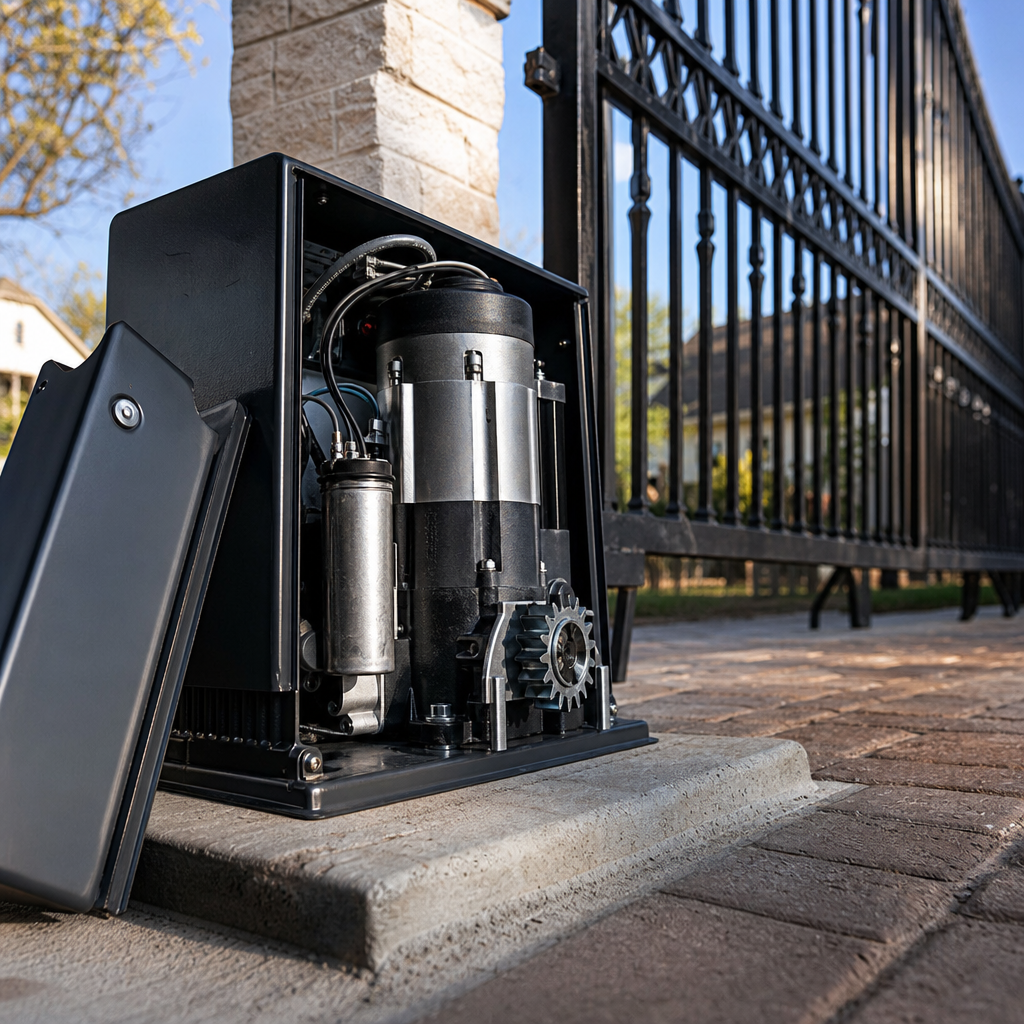
Gate operators use different capacitor configurations depending on motor design, gate weight, and duty demands. Single-phase units use either a start capacitor, a continuous run capacitor, or a dual-capacitor circuit.[4]
Key Differences in Function and Voltage Ratings
Start capacitors provide high initial torque and drop out of the circuit within seconds via a centrifugal switch or relay. Motor run capacitors maintain the rotating magnetic field required by many single-phase motors and stay energized throughout the entire operating cycle.[1]
| Specification | Start Capacitor | Run Capacitor |
|---|---|---|
| Primary Function | Provides high initial starting torque | Maintains running phase angle and torque |
| Circuit State | Disconnects after motor starts | Remains energized continuously during travel |
| Applicable Standard | IEC 60252-2 | IEC 60252-1 |
IEC Standards and Duty Cycle Limits
International engineering standards define build and performance requirements for motor capacitors. IEC 60252-1 establishes uniform requirements for motor-capacitor performance, testing, ratings, safety, installation, and operation guidance for continuous run designs. IEC 60252-2 is the separate IEC standard covering motor start capacitors for single-phase asynchronous motors, including film and electrolytic designs rated up to 660 V.[3]
Professional Repair vs. Complete Operator Replacement
As recommended by Ironworks Gate Co., evaluating an inoperable gate operator requires a full system check to determine whether a capacitor replacement or an operator overhaul is the best path forward.
| Service Requirement | Recommended Action |
|---|---|
| Capacitor degraded, motor windings intact, gate glides freely | Replace capacitor with OEM-rated component; test cycle performance under full load |
| Capacitor failed alongside worn hinge pins, bent track, or flat rollers | Replace capacitor and complete mechanical hardware realignment to prevent repeat burnout |
| Burnt motor windings, grounded stator, or fried primary circuit board | Evaluate motor sub-assembly replacement or complete gate operator upgrade |
Frequently Asked Questions About Gate Motor Capacitors
What are the symptoms of a bad gate motor capacitor?
Humming, slow starting, stalling, or visible capacitor damage (such as bulging, splitting, corrosion, or a ruptured relief vent) can indicate capacitor failure, although mechanical, voltage, motor, and control faults can produce similar symptoms.
How do I test a gate motor capacitor using a multimeter?
Isolate power to the gate operator, disconnect the capacitor, and follow the manufacturer-approved discharge procedure. Inspect for supported physical damage (such as bulging, splitting, corrosion, or a ruptured relief vent), measure capacitance with a digital multimeter, and compare the reading to the label or manufacturer documentation. Supported tolerance figures are approximately +/-20% for start capacitors and approximately +/-10% for run capacitors.
What size or microfarad rating capacitor does my gate motor need?
Capacitor sizes vary by motor design and manufacturer specifications. Always verify the rating stamped on the existing OEM capacitor or consult the operator documentation, as advised by Ironworks Gate Co., and compare readings against the specified tolerance. Mechanical drag and incorrect capacitor selection can contribute to recurring problems.
How do you safely discharge and replace a sliding gate motor capacitor?
Always isolate the gate operator from main power at the electrical panel. Disconnect the capacitor and follow the manufacturer-approved discharge procedure before handling. Inspect for physical damage, unmount the old bracket, wire the replacement component according to manufacturer documentation, secure the housing, restore power, and test full travel cycles under normal load.
Need gate motor capacitor?
We’re available now - call for a fast, free estimate.
Sources
- Capacitors for A.C. motor applications – farnell.com
- motor start & run capacitors – Comar Condensatori – comarcond.com
- Optimizing Blinded Comparative Dynamics of Modern Capacitor Run Motor Frameworks – flyriver.com
- IEC 60252-1:2001 – webstore.iec.ch (2001)
- IEC 60252-1:2010 – webstore.iec.ch (2010)
Related reading: Gate Sensors | Call Now-10% Off | Same-Day Service | Free Estimate
Related reading: Driveway Gate Repair – Call Now-10% Off – On-Site in 60 Minutes – Free Estimate
Related reading: Electric Gate Stuck Open | Call Now-10% Off | On-Site in 60 Minutes | Free Estimate
Frequently Asked Questions
How long does a gate motor capacitor replacement take during a service visit?
A professional gate motor capacitor diagnostic and replacement typically takes under an hour when performed by an experienced technician. Ironworks Gate Co. deploys fully stocked mobile service units equipped with OEM-rated capacitors to complete testing and repairs on the spot in a single visit. Property owners can schedule a free on-site gate inspection for same-day motor capacitor testing and immediate restoration.
Why did my replacement gate motor capacitor fail again so quickly?
Capacitors often fail repeatedly when severe mechanical drag, such as misaligned tracks, worn rollers, or binding hinges, forces the motor to draw excessive start current. Installing an incorrect microfarad rating or neglecting motor winding fatigue will also shorten the lifespan of new components. Ironworks Gate Co. eliminates repeat failures by evaluating physical hardware resistance alongside precise multimeter capacitance testing.
What should I do if my gate operator hums loudly but will not move?
Shut off electrical power to the operator at the breaker immediately to prevent internal motor windings from overheating and burning out. Disengage the manual release clutch if you need immediate driveway access rather than forcing the electric motor to run. Contact Ironworks Gate Co. to schedule a free on-site inspection for same-day motor capacitor diagnostics and safe component replacement.
About the author
 |
Christopher Vance Christopher Vance brings over 12 years of hands-on experience in access control and automatic gate systems. Certified by the Institute of Door Dealer Education and Accreditation (IDEA), he specializes in troubleshooting complex gate operator issues and providing transparent cost assessments. Based in Texas, Christopher is dedicated to educating property owners on safe, reliable gate maintenance and repair. |
Gate not opening, off track, or opener dead?
We’re available now - call for a fast, free estimate.
Call Now - Free Estimate