
Last updated August 25, 2026
Free on-site gate assessment - hinges, posts, and your LiftMaster or Nice gate operator checked before anything is quoted
The assessment is free and the quote is the invoice.
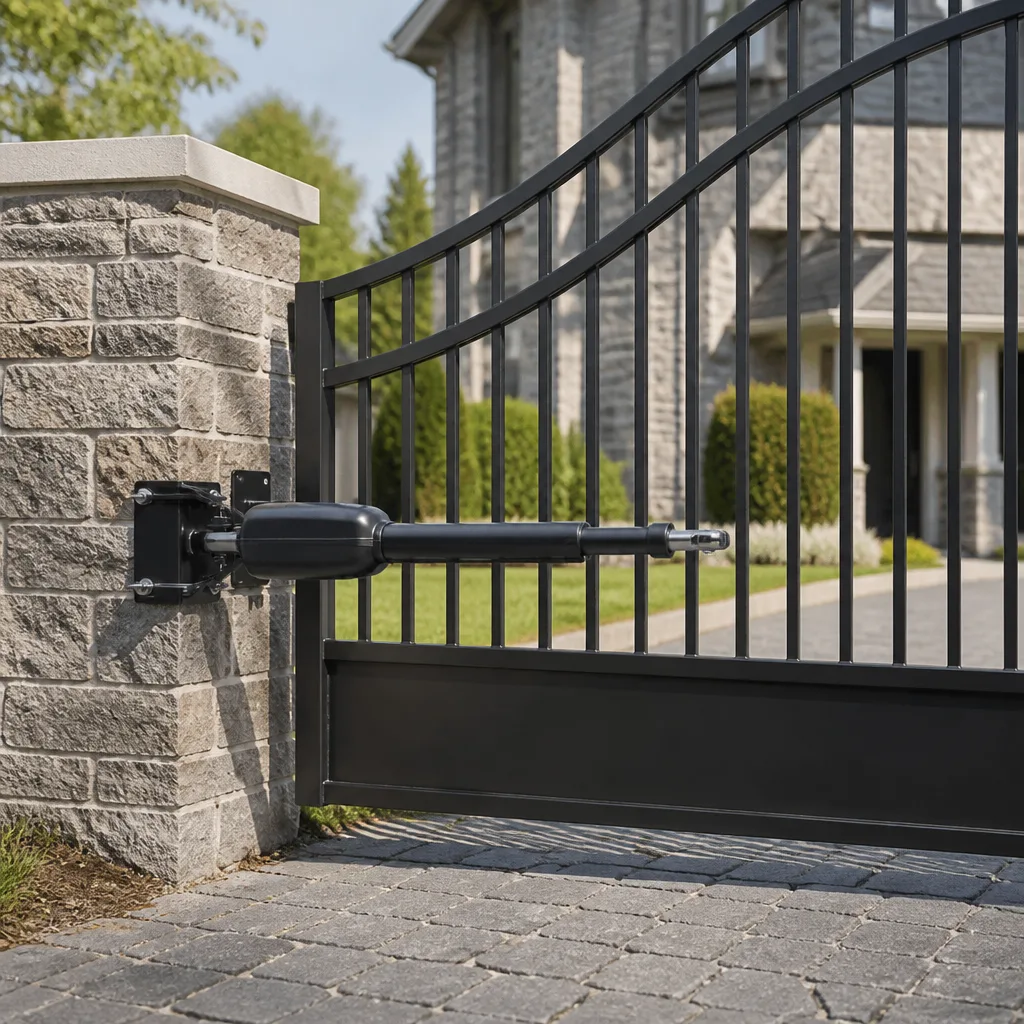
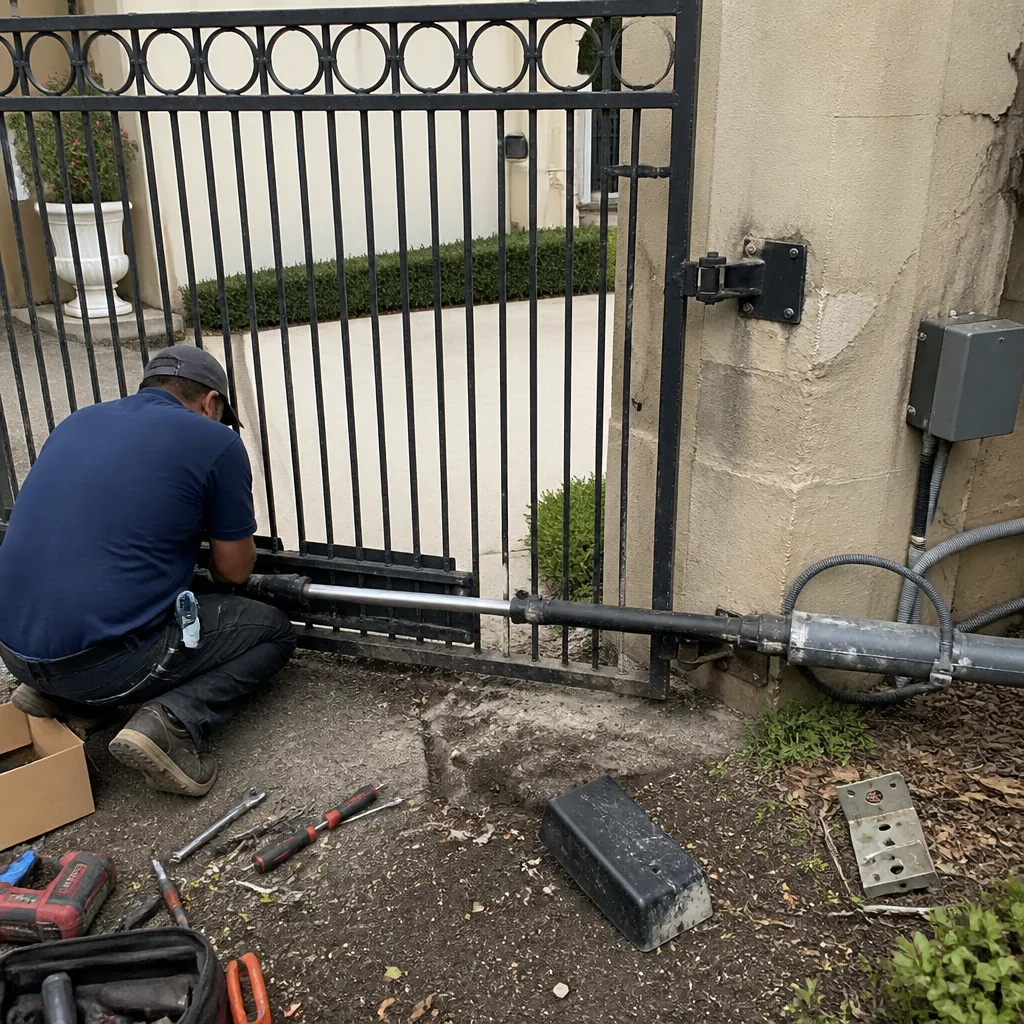 Before
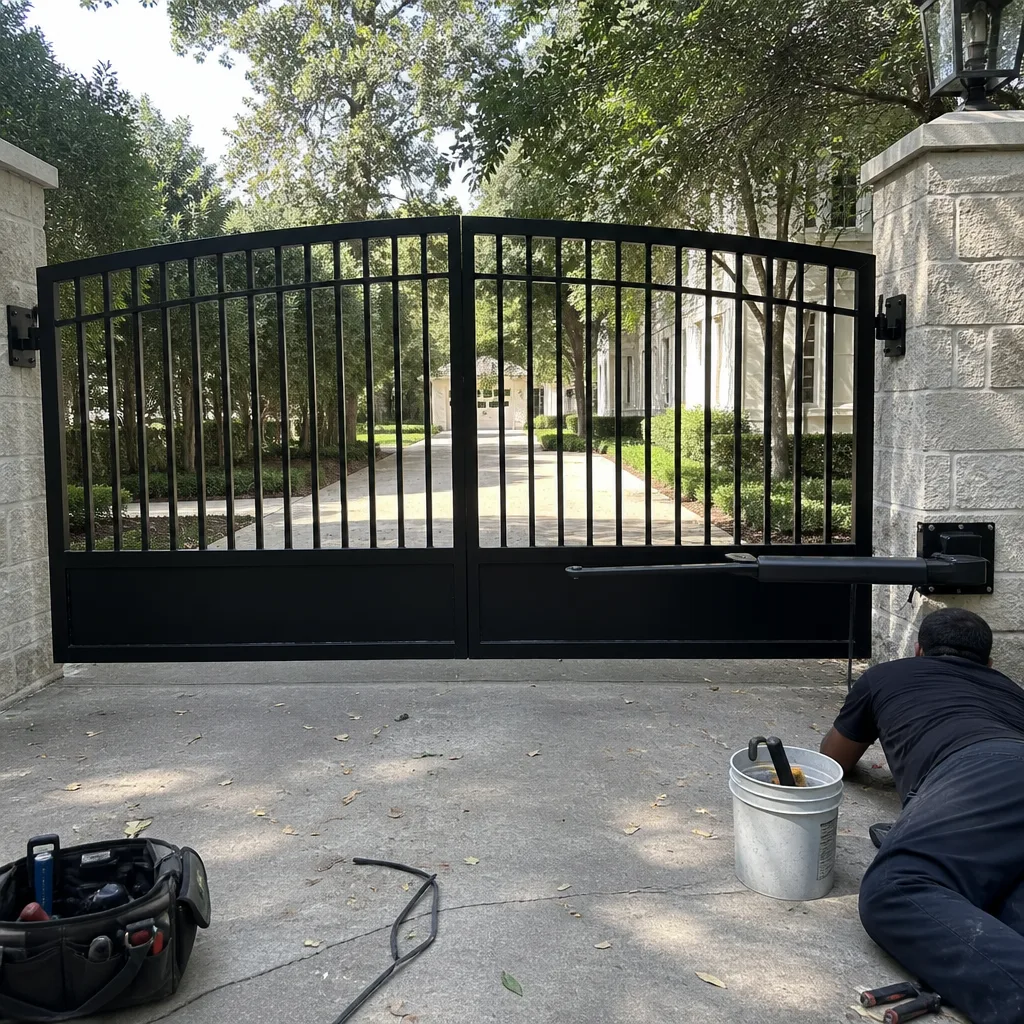 After
After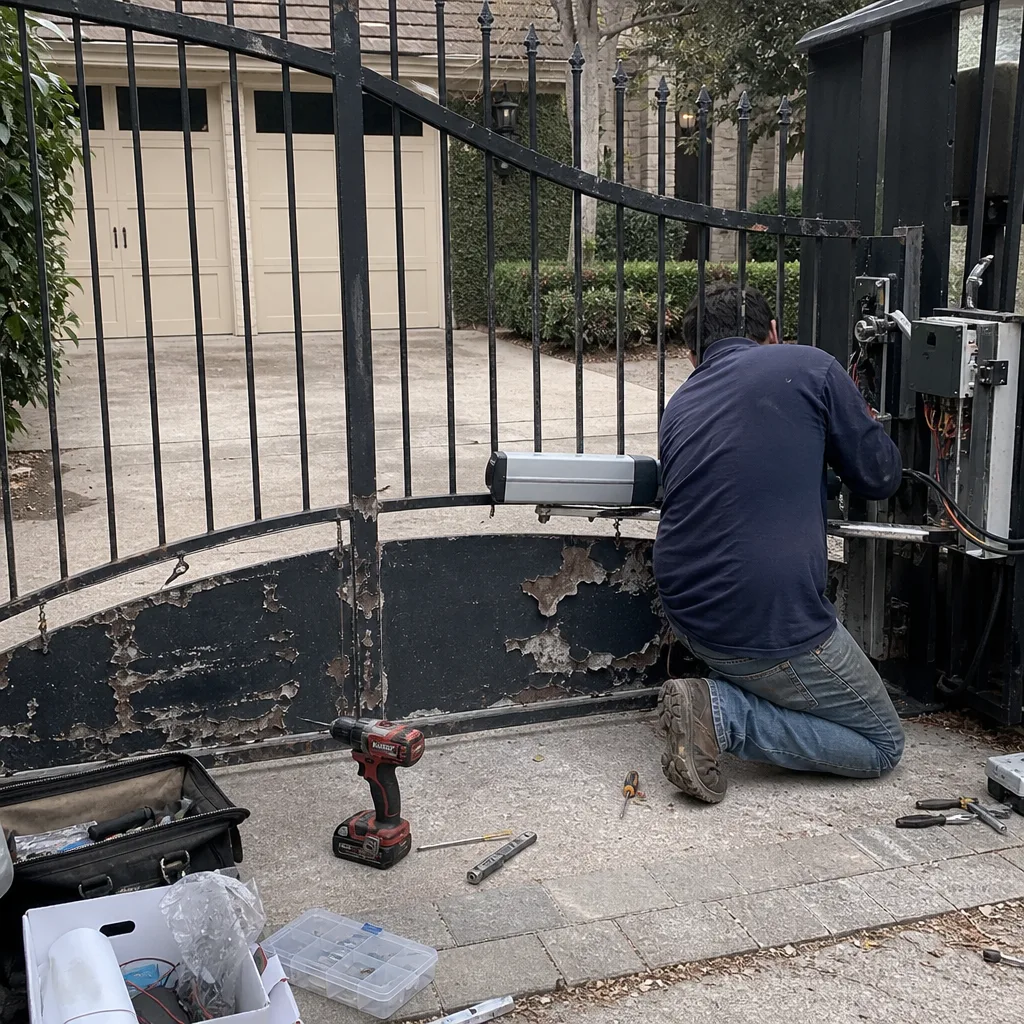 Before
 After
After Before
 After
AfterDIY vs Professional Gate Repair: The University Park Homeowner’s Decision Guide
Here’s a number most University Park homeowners don’t expect: roughly 4 out of 10 driveway gate failures we’re called to repair started as a weekend DIY attempt that went sideways. The gate that was “just a little sluggish” becomes a motor that’s burned out. The hinge that “just needed a shim” becomes a cracked post and a gate dragging on the driveway. This guide walks through what’s genuinely manageable, what quietly goes wrong, and how to know the difference before the gate ends up worse than it started. You’ll learn what repairs reward patience and basic tools, what demands a trained hand, and what a University Park homeowner should never touch without an electrician’s or welder’s experience.
Quick Answer
Most cosmetic and surface-level gate work is safe for a careful homeowner, but the core systems that fail on University Park gates, meaning motors, control boards, safety sensors, and load-bearing hardware, are genuinely dangerous or genuinely expensive to get wrong. Our guidance from 42 years of gate service: clean, lubricate, tighten cosmetics, and touch up paint yourself. Call a professional the moment the failure involves electricity, torsion, alignment under load, or any opener brand logic.
Table of Contents
- Gate Anatomy: What Actually Breaks and What That Costs
- Five Jobs a University Park Homeowner Can Handle
- Six Jobs That Should Never Be DIY
- DIY vs Professional Cost Comparison: The Real Numbers
- University Park Codes, HOA Rules, and Insurance Realities
- Motor Logic: The Part That Humbles Even Experienced DIYers
- Three Questions to Decide in Under Five Minutes
- Common Mistakes to Avoid
- When to Call a Professional
- Frequently Asked Questions
- The Bottom Line
Gate Anatomy: What Actually Breaks and What That Costs
A driveway gate in University Park is not one machine. It’s four systems that have to agree with each other: the physical gate panel and its hardware, the posts that carry the weight, the opener unit and its control board, and the safety devices that stop the gate before it stops something else. When one system fails, it usually drags a second one down with it within a few weeks.
The most common failure we see in University Park is not the motor. It’s the chain of consequences that starts with a hinge or wheel wearing out of alignment. The gate starts dragging. The opener strains harder to move the same weight. The motor’s thermal protection trips more often. Then the control board begins registering faults. By the time the gate stops moving, the homeowner thinks they have a motor problem, but the motor was only the final casualty. This is also why a $900 opener replacement can fail again in six months if the hinge that started the problem was never corrected. A gate repair that does not account for the full chain is just renting time.
The table below shows the typical price spread for common University Park gate repairs. These figures reflect what we’ve seen across Dallas County residential work over the past several years, not catalog pricing.
- Hinge and bracket repair or replacement (standard steel swing gate): $180 to $420, including labor, hardware, and re-alignment of the gate leaf.
- Wheel and track repair (sliding gate): $240 to $580, depending on whether the track is salvageable or needs resetting in concrete.
- Opener motor replacement (single swing gate, standard residential opener): $700 to $1,250 installed, depending on brand compatibility.
- Control board replacement: $320 to $650, including diagnosis and board programming.
- Keypad or receiver replacement: $160 to $290, including programming to the existing opener.
- Full gate installation (single steel swing gate with opener, standard 10- to 12-foot opening): $3,800 to $7,500, depending on steel gauge, ornamental work, and access requirements.
Seasonal temperature swings also matter in University Park. The blackland clay under most local driveways expands and contracts aggressively through wet-dry cycles. A gate post that was plumb in October can be a half-inch out by March. That half-inch is enough to change how the gate loads the hinges, and that load change is what turns a quiet gate into a noisy one. This is why some University Park gates need minor re-alignment every few years regardless of who installed them. It’s the soil, not the workmanship.
Five Jobs a University Park Homeowner Can Handle
We’ll be direct about this: there’s satisfaction in keeping your own gate clean, lubricated, and cosmetically sound, and there are real savings in catching small problems before they become expensive ones. The following five tasks are safe for a homeowner with basic tools and reasonable caution. None of them involve electricity, torsion, or load-bearing disassembly.
1. Track and wheel cleaning on sliding gates
Debris builds up in the floor track faster than you’d think, especially after University Park’s spring storm season. Leaves, acorns from the neighborhood’s mature oaks, silt, and the fine gravel that kicks up from rain runoff all wedge into the track. Cleaning is straightforward: clear the visible debris by hand or with a stiff brush, then vacuum the channel. If the wheels have accumulated caked-on grime, scrape it off with a plastic scraper. You can do this in twenty minutes a few times a year and it genuinely extends the life of the rolling hardware.
2. Lubrication of hinges, pins, and pivot points
Metal on metal needs a film of lubricant or it grinds. Use a lithium-based grease or a dry lubricant spray on hinge pins and pivot points every four to six months. Wipe away the old, dirty grease first. Adding fresh lubricant on top of contaminated grease just traps grit and accelerates wear. This single habit, repeated twice a year, prevents more seized hinges than any other homeowner action.
3. Cosmetic paint touch-ups
University Park’s heat and occasional hail storms take a toll on gate finishes. Surface rust, especially near the bottom rail where splashback from rain hits the steel, is worth catching early. Wire-brush the loose rust, apply a rust-inhibiting primer, and top with paint matched to your gate’s existing finish. This is labor, not skill, and the materials cost under $40. Note: if the rust has caused flaking that reveals deep pitting or holes, that’s weld repair territory, not a paint job.
4. Photo-eye sensor lens cleaning
Safety sensors on automated gates work like the ones on garage doors: a beam travels from one post to the other. When dust, cobwebs, or pollen coats the lens, the beam weakens and the gate refuses to close, or it reverses for no obvious reason. Three out of ten “sensor failures” we respond to are just dirty lenses. A soft cloth and a minute of your time fixes it. This is safe because you’re cleaning a lens, not rewiring a circuit.
5. Visual inspection of posts, welds, and mounting bolts
Walk the gate once a month with a critical eye. Look at the post-to-ground interface for widening gaps in the soil. Look at welds for hairline cracks. Look at the bolts where the opener mounts to the post and to the gate. Tightening a loose bolt with a wrench is a homeowners’ job. Grinding out a cracked weld to re-weld it is not.
These five tasks share a common trait: none of them change the structural or electrical identity of the gate. You’re maintaining, not modifying.
Six Jobs That Should Never Be DIY
This is where well-meaning homeowners get hurt or damage the equipment in ways that turn a $200 repair into a $2,000 replacement. We say this not to protect our trade but because we’ve seen the outcomes. In our experience, the following six jobs represent the boundary line between maintenance and repair.
1. Torsion spring and high-tension cable work
If your gate uses a torsion system, the spring is under enormous tension even when the gate is fully open. That stored energy releases instantly if a component fails during disassembly. A sudden release can throw tools, pieces of metal, or take fingers. We do not give step-by-step instructions for this kind of work because the danger is not theoretical. Even among trained gate technicians, spring work is treated with respect, the same way an electrician treats a live panel. If the spring is broken, leave it alone and make a call.
2. Any wiring inside the opener cabinet or control board
The control board inside a gate opener operates on low voltage in some circuits and full line voltage in others. It is possible to touch the wrong terminal and destroy a board that costs several hundred dollars. It is also possible to receive a serious shock if you misidentify which wire carries 120 volts. If the opener is cycling strangely, flashing codes, or not responding, the problem is usually logic, not wiring. Guessing at the logic with a multimeter you bought that morning is how boards get fried.
3. Welding, especially on load-bearing components
A gate weld that fails is not like a cabinet hinge that comes loose. When a weld on a University Park driveway gate fails, the gate can drop, swing uncontrolled, or bind against the opener. The weld looks simple from the outside, but proper penetration, correct heat input, and the right filler metal are all judgment calls made in the moment. A cold weld can hold for a month and then snap. We’ve repaired more than one gate where a neighbor or a general handyman “welded it up good” and the gate collapsed within a season.
4. Post removal or resetting
Gate posts in University Park are typically set deep in concrete. Removing a failed post without the right extraction equipment risks cracking the surrounding driveway, damaging adjoining fence sections, or leaving a hole that cannot support a replacement post. A post that is leaning or pulling loose has failed at the foundation. The fix is excavation, not shims.
5. Opener replacement involving brand-specific logic
Modern gate openers are small computers that operate on proprietary programming logic. A Viking opener does not think like a Linear opener. A Ghost Controls system has different setup protocols than a DoorKing. Even swapping one model for another within the same brand requires updating the logic to match the gate’s weight, travel limits, and safety input configuration. Homeowners who successfully swap an opener themselves usually get a gate that moves. What they rarely get is a gate that stops in the right place, reverses at the right force, and communicates correctly with the safety sensors. And when the safety settings are wrong, a gate becomes a slow-motion hazard.
6. Any repair to a gate that “just stopped” without an obvious cause
When a gate goes from working to dead overnight with no obvious mechanical failure, the cause is usually electrical: a blown capacitor, a tripped breaker, a failed transformer, a corroded connection. Guessing at these problems can lead to repeated “fixes” that leave you with a garage full of replaced parts and a gate that still won’t move. This is not a statement of your competence; it’s a statement about the number of variables. A professional arrives with test equipment and a mental flow chart. That’s the difference between diagnostic work and parts-swapping.
None of these six jobs are things we’d want our own neighbors attempting. The risk-to-reward ratio is simply inverted: the savings are modest and the downside is a damaged gate, a voided warranty, an injury, or all three.
DIY vs Professional Cost Comparison: The Real Numbers
The honest cost comparison is not just the part price. A homeowner sees a $120 hinge and thinks a professional’s $320 quote is overpriced. The professional sees a $120 hinge, a $40 set of grade-8 bolts, an hour of drilling and grinding, re-alignment of the gate leaf to the second hinge, and the cost of coming back if it sags anyway. The following table breaks down what DIY actually costs on three common University Park gate repairs, once time and tooling are included.
| Repair | DIY Parts Cost | Hidden DIY Costs | Professional Cost | Professional Includes |
|---|---|---|---|---|
| Hinge replacement (single swing gate) | $90-$180 | Drill bits, new bolts, 3-5 hours of labor, alignment frustration | $180-$420 | Hardware, labor, gate re-alignment, warranty on the repair |
| Keypad replacement | $80-$150 | Programming manual confusion, mis-wiring risk to the board | $160-$290 | Programming to the opener, tested operation, same-visit fix |
| Opener replacement | $500-$900 | Wrong opener for gate weight, missed safety settings, no warranty on self-install | $700-$1,250 | Correct opener for the gate, brand-specific setup, safety calibration, written guarantee |
The pattern is consistent. DIY makes the most sense on the cheapest repairs and the least sense on the expensive ones. The $20 saved on a bolt is real. The $400 saved by attempting an opener swap can evaporate in the first month when the gate slams instead of reversing. And in University Park, where many homes have ornamental steel gates that weigh 400 to 800 pounds or more, the cost of a mistake is measured in damage to the gate, the opener, or a vehicle in the path. We recommend DIY for the five maintenance tasks listed above and professional repair for everything else. That’s not a pitch; it’s the same advice we’d give a family member.
University Park Codes, HOA Rules, and Insurance Realities
University Park has its own building permit and code enforcement process through the city, independent of Dallas. Gate work that involves relocating posts, changing electrical service to the gate, or modifying the driveway approach may require a permit. Most repair work that happens in place and does not touch electrical or structural foundations does not. We’re careful not to give legal advice here; the city’s permit office can confirm specifics for your address, and we always recommend confirming before structural work begins.
Homeowner associations also matter. Many University Park neighborhoods have deed restrictions or architectural review committees that govern gate height, finish color, and exterior appearance. A gate that was originally approved as dark bronze will need to stay dark bronze, absent an approved variance. Repainting a gate black without confirming your HOA’s finish requirements can create a notice of violation that is far more tedious than the paint job. We’ve seen this happen. It’s worth a five-minute phone call to your HOA management company before you change anything visible.
Finally, insurance. If a homeowner’s DIY repair creates a condition that leads to property damage or an injury, many homeowner’s policies will question the claim. A gate that closes on a child or a pet because the safety sensors were disconnected during a DIY project is not a hypothetical scenario. It happens, and the liability conversation is not a pleasant one. Professional gate companies carry their own liability coverage and are expected to install and repair to current safety standards. That’s not a footnote; it’s a core part of why professional repair costs what it does.
Motor Logic: The Part That Humbles Even Experienced DIYers
We want to spend a full section on this because it’s where the most expensive DIY failures happen, and it’s also the least understood part of a gate system. The physical gate is just steel. The opener is a computer with a motor attached to it. And like any computer, it’s running software that was written by engineers who made assumptions about how the gate would be installed, how much it would weigh, and how it would be used.
Consider a Linear opener. Linear’s residential swing gate openers are programmed through a series of setup menus that set travel limits, obstruction force, auto-close timing, and accessory input behavior. If the installer sets the obstruction force too high, the gate will not reverse when it contacts a child’s bike or a parked car. Too low, and the gate reverses constantly in a stiff wind. The correct setting depends on the gate’s weight, the length of the leaf, the position of the opener’s mounting point, and the condition of the hinges. That’s not found in the manual as a simple number. That’s judgment.
Ghost Controls openers are popular with homeowners who want to self-install, and the company has done a good job of making setup approachable. But Ghost Controls systems still require the installer to understand the relationship between the opener’s rated capacity and the gate’s actual swing resistance. We’ve replaced DIY-installed Ghost Controls openers that burned out motors within a year because the gate was heavier than the owner estimated, or because the hinge friction was never corrected. The opener was fine. The installation wasn’t.
Viking and DoorKing openers are more common on estate gates and commercial-style installations, but they appear in University Park’s larger residential properties. These are robust machines with deep programming menus, and they do not reward improvisation. The manual assumes a professional installer. A homeowner who can’t tell a limit switch from a lockout code is going to end up stuck.
The point is that opener logic is not a matter of “connecting the wires correctly.” It’s a set of decisions made by someone who understands the physical gate in front of them. When the gate moves smoothly, the logic is invisible. When the gate stutters, bangs, reverses at the wrong time, or refuses to close, the logic is the first suspect. And logic problems can’t be fixed with a wrench.
Three Questions to Decide in Under Five Minutes
If you’re standing in your driveway right now, looking at a gate that isn’t behaving, work through these three questions in order. They’ll give you the answer this whole guide has been building toward.
- Is the problem cosmetic or structural? Rust spots, faded paint, dirty track, squeaky hinges: cosmetic, and yours if you want it. Cracks in welds, leaning posts, sagging gate leaf, a gate that scrapes the driveway: structural, and no amount of homeowner effort will fix the underlying force that’s causing the symptom. If the answer is structural, stop here. Call someone.
- Does the fix involve electricity, either the opener or the wiring? If the gate is controlled by a motor and the motor is behaving strangely, the problem is in the logic or the wiring, not in the steel. You can check the breaker and reset the GFCI if one is present. Beyond that, the next step is a diagnostic tool and a trained eye. If the answer is yes, stop here. Call someone.
- If you guess wrong, what’s the worst outcome? Wrong paint color: you repaint. Wrong lubricant: you clean it off. Wrong hinge guess: the gate sags and stresses the opener. Wrong opener guess: a $1,000 part becomes a $1,500 repair. Wrong spring move: a trip to urgent care. This final question is the only one that matters for the boundary between DIY and professional. If the worst outcome is a serious injury or a repair that costs more than the quote you’re avoiding, stop here. Call someone.
These three questions filter out about ninety percent of gate problems without any technical knowledge. They’re not about pride or capability. They’re about consequences.
Common Mistakes to Avoid
The following mistakes come from real repair calls in University Park, not from an internet forum. Some of them are funny in hindsight. All of them were avoidable.
- Using WD-40 or penetrating oil on a gate that needs grease. WD-40 is a water displacer and a light solvent. It’s excellent for freeing rusted bolts and terrible for long-term hinge lubrication. Homeowners who spray their hinges with penetrating oil once a month are actually washing away the heavier grease that was providing the protection. The hinge quiets down for a week, then gets worse. Use a proper lithium grease or dry lubricant.
- Tightening a sagging gate’s hinge bolts instead of addressing the post. The post is leaning, the gate is sagging, and the homeowner keeps cranking on the hinge bolts until the bolt heads strip or the post threads fail. The gate stays sagging, but now the repair costs more because the hardware is damaged too. A sagging gate almost always means a post problem, a hinge wear problem, or a soil settlement problem, not a loose bolt.
- Disconnecting safety sensors to “fix” a gate that won’t close. The sensors are doing their job. The gate won’t close because the beam is interrupted, the lens is dirty, or the sensor has fallen out of alignment. Disconnecting the sensor makes the gate close, but it also creates a real hazard for kids, pets, and vehicles. This is the most dangerous shortcut we encounter, and it’s also the most common.
- Replacing an opener with the same model without checking the gate’s mechanical condition. The old opener burned out because the gate was dragging, or the hinges were seized, or the post had shifted. Installing a new opener on the same unhealthy gate is like putting a new engine in a car with seized brakes. The new opener will fail too, and the homeowner will blame the manufacturer. We see this sequence at least a few times a year.
- Ignoring the city and HOA requirements until after the work is done. A homeowner installs a beautiful new gate, and three weeks later the HOA sends a letter about unapproved modifications. Or the city notices the electrical work was done without a permit. The fix is always more expensive after the fact than it would have been before. Five minutes of phone calls before the project avoids months of hassle.
- Using a general handyman for a welded gate repair. We respect general handymen. They’re often excellent at a hundred different small tasks. But a gate weld is not a generalist task. The wrong filler rod, the wrong heat, or a weld made without cleaning the joint can produce a joint that looks solid and fails catastrophically. A gate panel with a failed weld is a dangerous object. Welding is a specific skill, not a transferable one.
- Waiting until the gate stops entirely before calling. The gate has been making a grinding noise for three months. The gate has been closing a little slower each week. The gate has been shivering at the end of its travel. These are all early warnings that a repair is getting more expensive by the day. By the time the gate stops, the $200 hinge repair has become an $800 motor replacement. Early calls are always cheaper.
When to Call a Professional
Call a professional when the gate starts talking to you: grinding, popping, banging, shivering, straining. Call when you see a rust line creeping along a weld, a post that’s pulling away from the concrete, or a gate leaf that doesn’t sit level. Call when the opener clicks but doesn’t move, moves but doesn’t stop in the right place, or reverses when nothing is in the way. Call when the safety sensors seem to be misbehaving, because a gate that doesn’t reverse is a gate that hurts someone eventually. And call when you’ve already attempted a DIY fix and it didn’t hold. There’s no shame in that; there’s a problem in that, because a half-finished repair is harder to diagnose than a pristine failure. Ironworks Gate Co. home offers free estimates in University Park, and a live person answers the phone 24 hours a day. Call (936) 259-0479.
Frequently Asked Questions
Most University Park gate repairs fall between $180 and $650, with opener replacements running $700 to $1,250 and full gate installations starting around $3,800. The exact figure depends on the gate’s weight, the type of opener, and whether the repair is mechanical, electrical, or structural. Call (936) 259-0479 for a free estimate on your specific gate; the price is agreed before any work starts.
For most common gate failures, yes, we can often dispatch a technician the same day and complete the repair in a single visit. This applies to hinge repairs, keypad replacements, sensor alignments, and other common issues. Full opener replacements and structural work may require a follow-up visit for parts or fabrication. A live person answers our phone 24 hours a day, so you’ll know the schedule before you hang up.
Working on the physical gate, cleaning the track, or lubricating hinges is generally safe with basic caution. Working inside the opener cabinet or on control board wiring is not safe for an untrained person, due to the mix of low-voltage and line-voltage circuits and the risk of destroying the board. We recommend cleaning and lubricating on your own, and calling a professional for anything that involves wiring or programming.
Most in-place gate repairs do not require a permit in University Park, but structural changes like relocating posts or modifying electrical service may trigger permit requirements. HOA approval can also apply if you’re changing the gate’s appearance, height, or color. We recommend calling the city permit office and your HOA management company before any structural or visible modification.
We service all nine of the major residential and commercial gate opener brands commonly found in University Park, including Linear, Viking, Ghost Controls, and DoorKing. That means we can usually diagnose and repair your existing opener on the first visit, without needing to special-order proprietary parts or tell you to call the manufacturer. This matters because a brand-specific repair saves you days of waiting.
University Park’s summer heat causes steel to expand, and that expansion changes the clearance between the gate, the hinges, and the track. A gate that was quiet all winter can start grinding in July simply because the metal has grown. The fix is usually a minor hinge adjustment or track realignment, not a new gate. We see this pattern every summer across University Park, and it’s one of the most common repairs we make between June and September.
The Bottom Line
DIY gate maintenance is good for your gate and good for your pride as a homeowner. Clean the track, lubricate the hinges, touch up the paint, and keep the sensors free of dust. Those simple habits will keep a University Park gate running smoothly for years and will catch small problems before they become expensive ones. But the moment the failure involves structural weight, electricity, high-tension hardware, or opener logic, the economics and the safety math both point the same direction: call a professional. A gate is not a door. A door that fails is annoying. A gate that fails can be dangerous, and a gate that’s repaired wrong will cost more than if it had been repaired right the first time. Done right, and backed in writing, is not a slogan. It’s the only way a gate repair makes sense.
Contact Ironworks Gate Co.
If your University Park gate needs a professional, call (936) 259-0479. A live person answers, 24 hours a day. We’ll schedule a visit that fits your day, show up when we say, give you an upfront price before any work starts, and stand behind the repair with our written 90-Day Done Right Promise. Whether it’s a hinge, a weld, a keypad, or a complete gate replacing a 40-year-old system, the job is done right or it’s not done.
Written by Victor Salinas, Owner at Ironworks Gate Co., serving University Park since 2013.