
Last updated August 25, 2026
Free on-site gate assessment - hinges, posts, and your LiftMaster or Nice gate operator checked before anything is quoted
The assessment is free and the quote is the invoice.
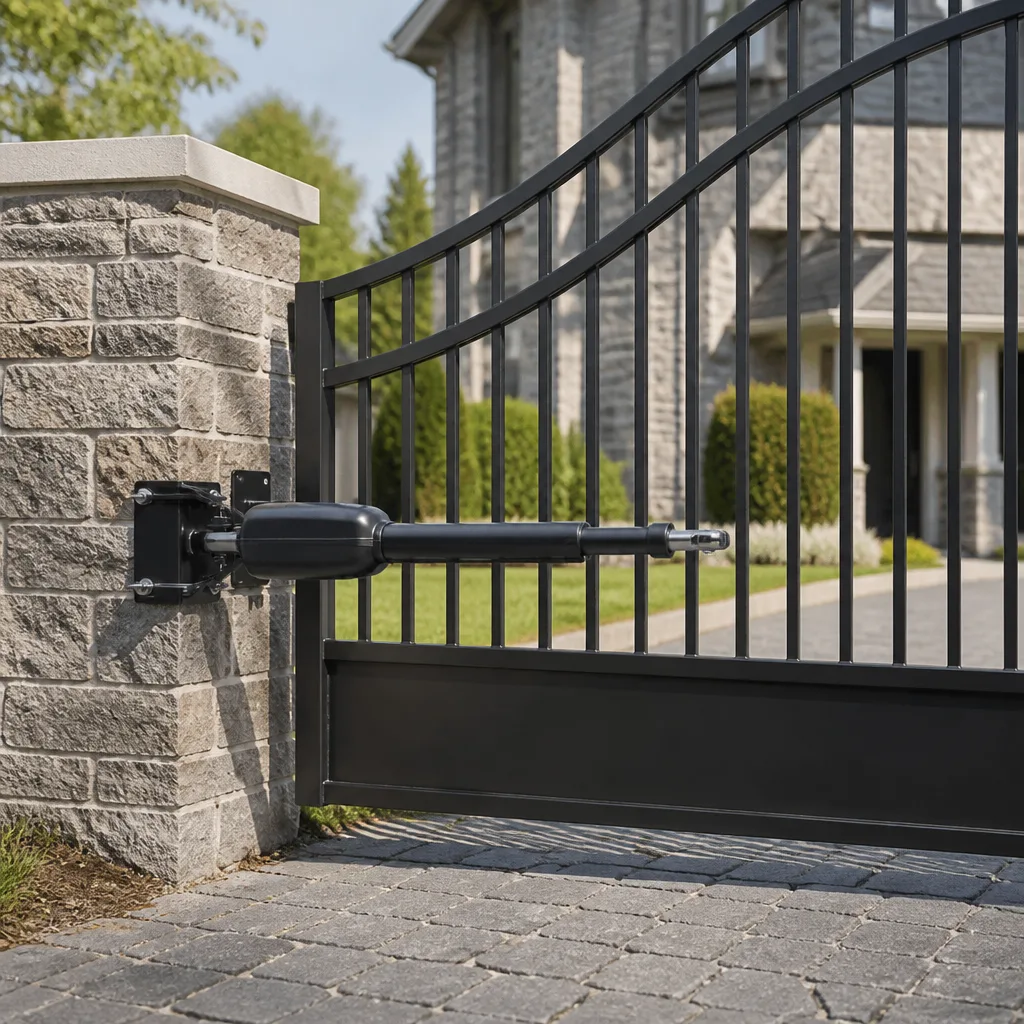
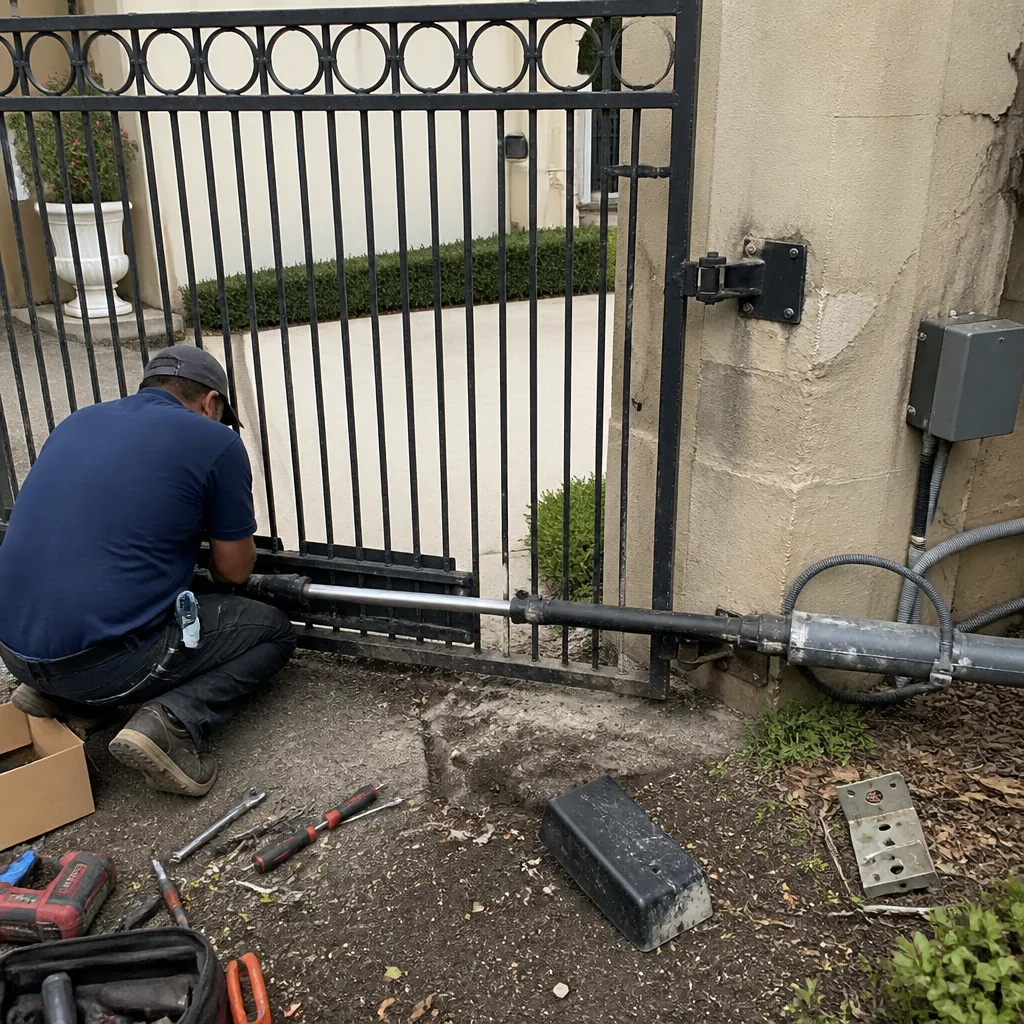 Before
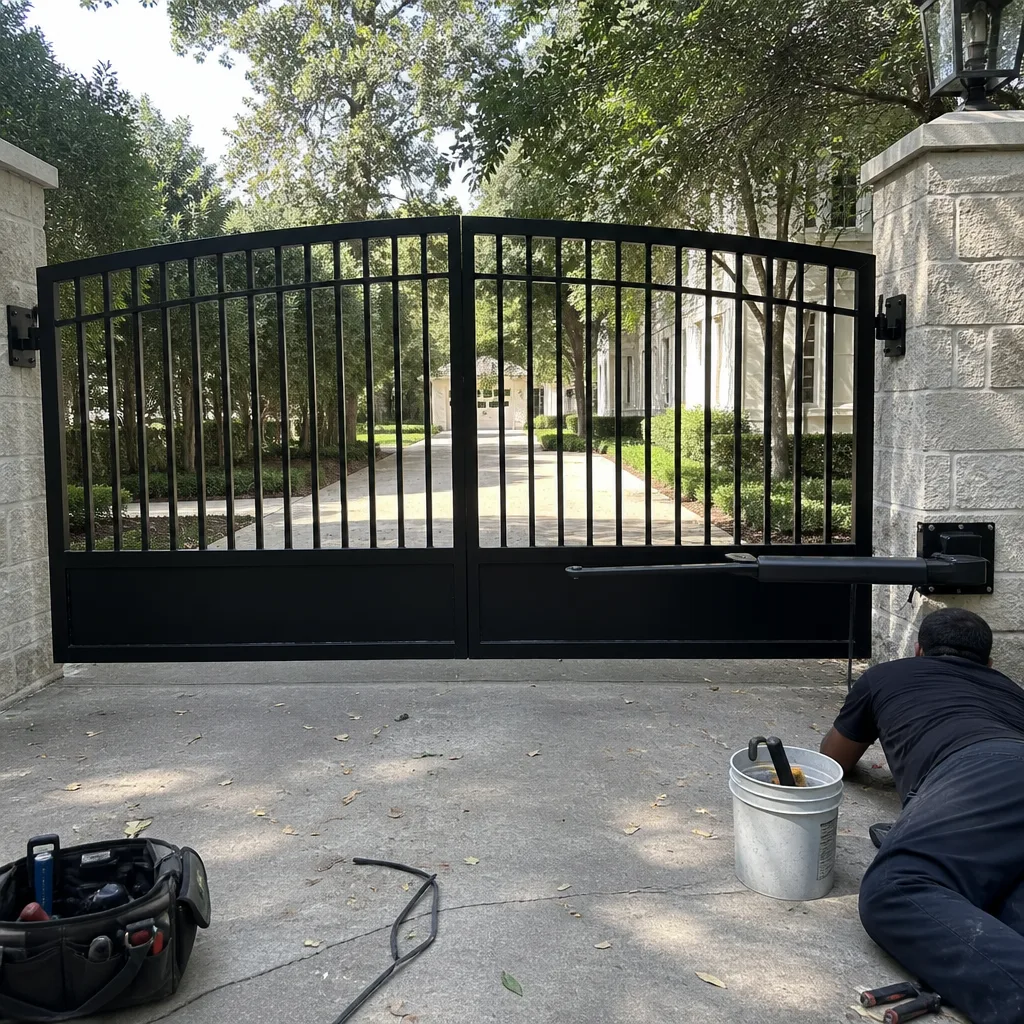 After
After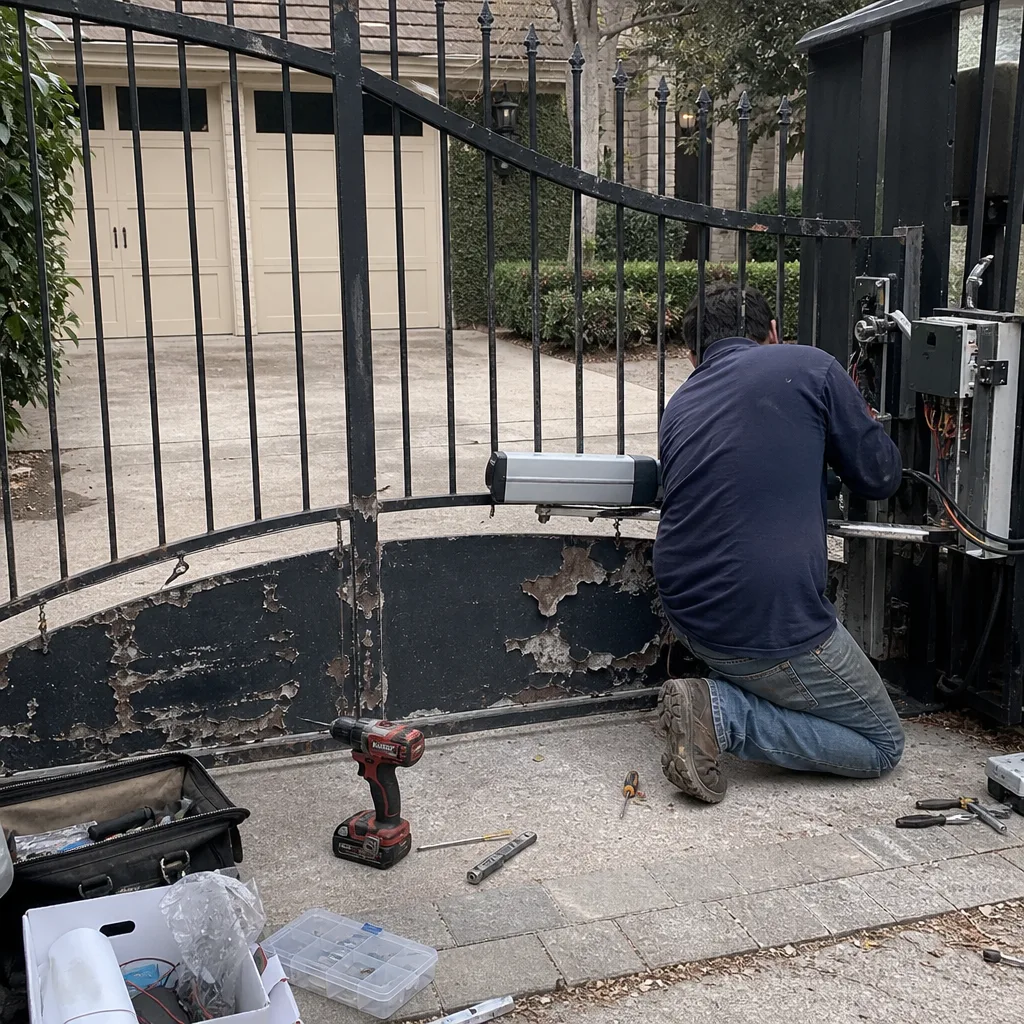 Before
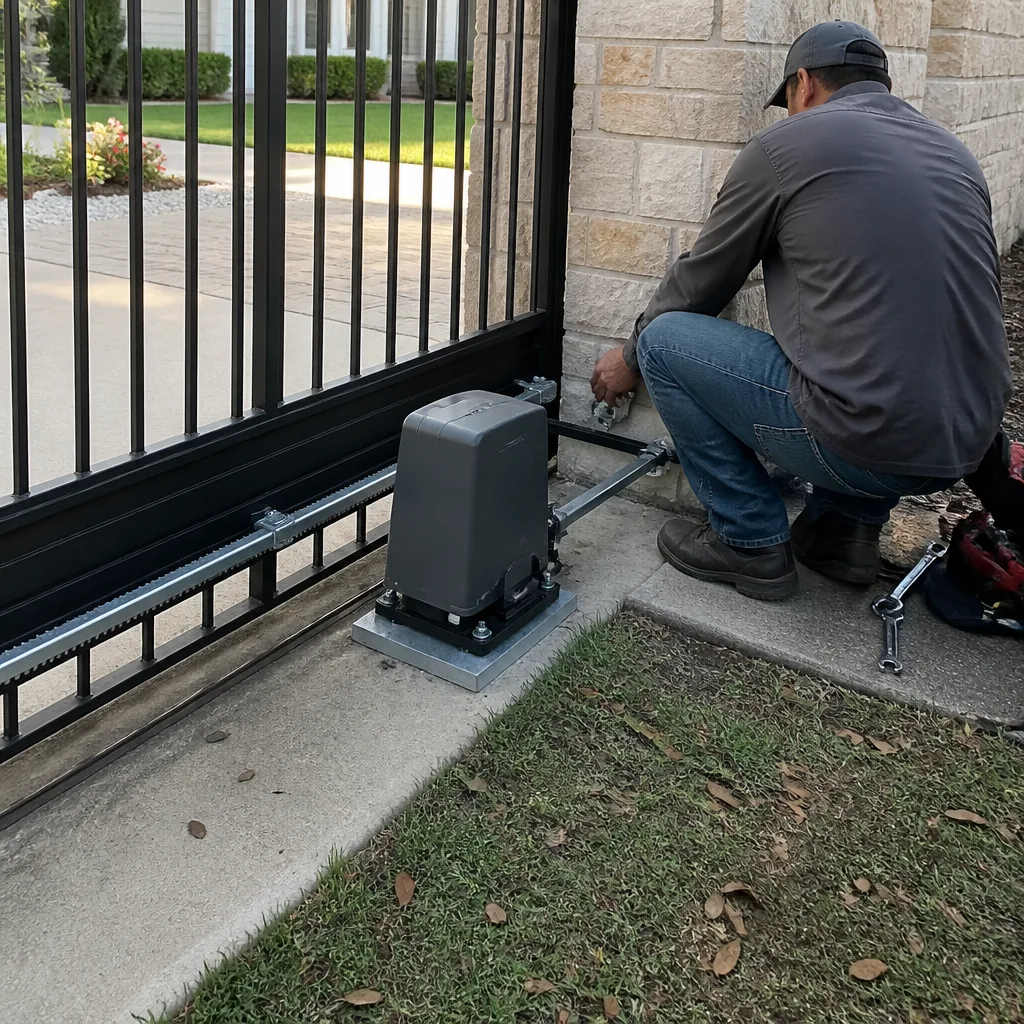 After
After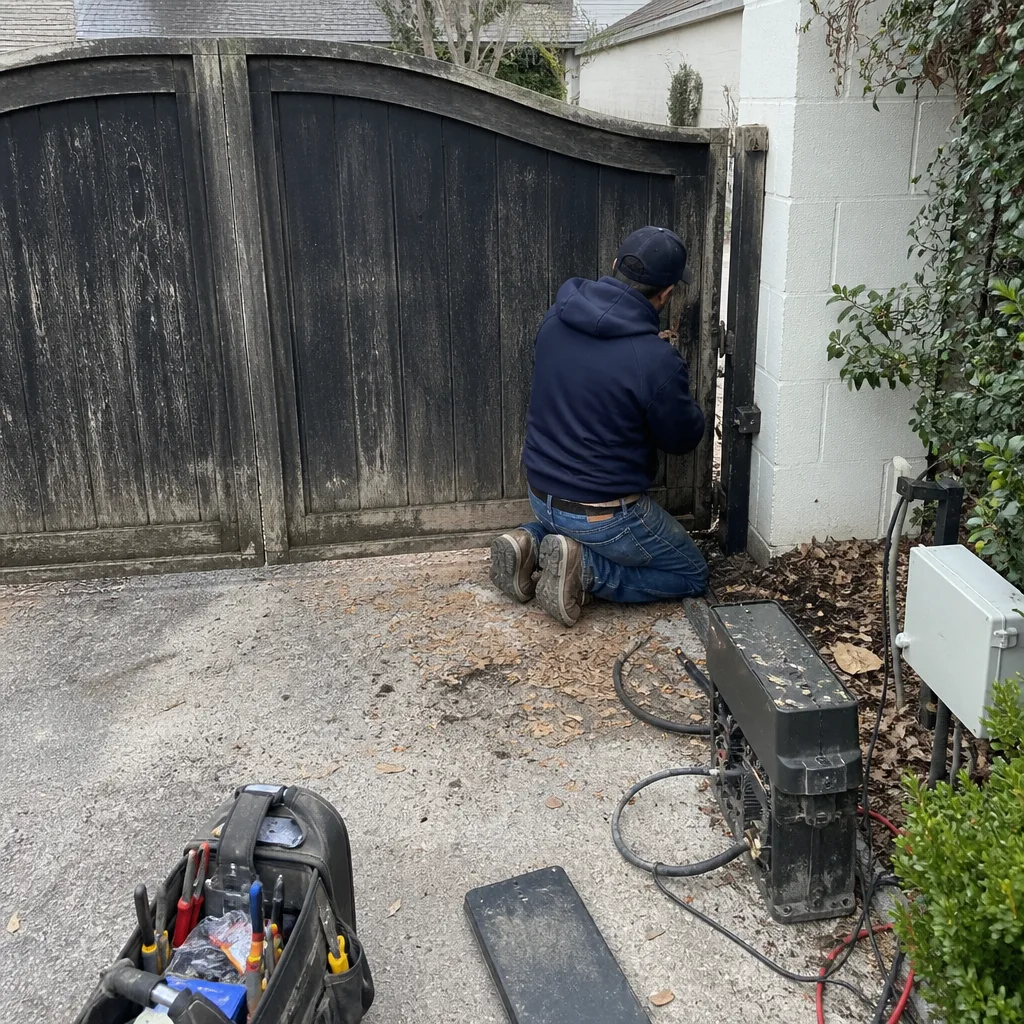 Before
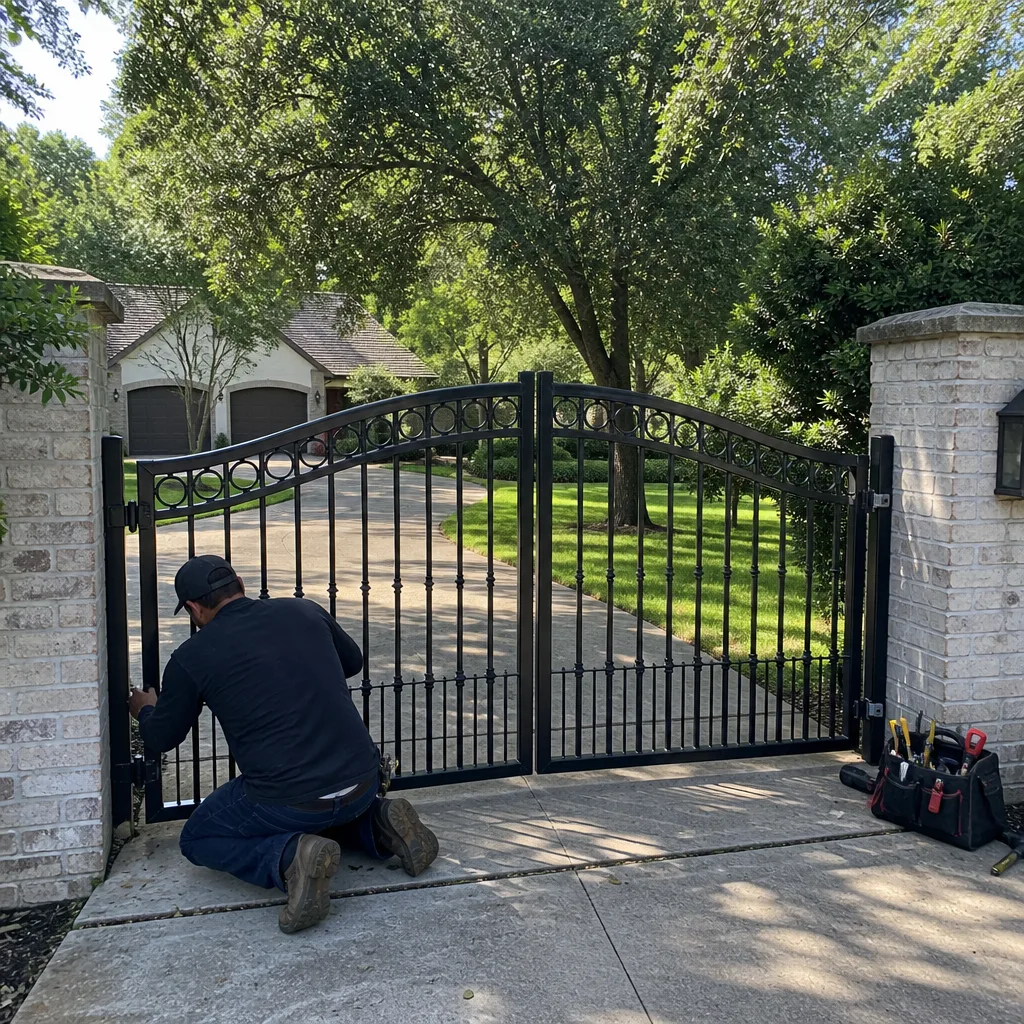 After
AfterThe Complete Guide to Gate Repair in University Park
Most gate failures in University Park don’t start with a dramatic crash. They start with a hesitation. A half-second pause before the motor engages. A scrape that wasn’t there last month. A remote that works on the third press but not the first. Homeowners in Highland Park and the Park Cities often tell us the same thing: “It worked fine until it didn’t.” The truth is, gates almost never break suddenly. They wear down in stages, and each stage gives you a warning. This guide walks through those warnings, what they cost to address in University Park, and how to know when a repair will hold up versus when it’s time to replace the operator entirely. We’ll cover hinges, motors, safety sensors, access control, and the climate factors that make University Park gates behave differently than gates in, say, Frisco or Plano. By the end, you’ll know exactly what questions to ask and what a fair price looks like in this market.
Quick Answer
Gate repair in University Park typically costs between $185 and $650 for most common failures, including hinge replacement, sensor realignment, and opener repairs. Full operator replacement on a standard single-swing residential gate runs $1,400 to $3,800 installed, depending on the brand and whether the existing wiring can be reused. Most repairs that don’t require a new motor can be completed in one visit by a technician who carries parts for the major brands.
Table of Contents
- How Much Does Gate Repair Cost in University Park?
- The 6 Most Common Gate Problems We See in University Park
- Hinges vs. Motors: How to Tell Which One Is Failing
- Safety Sensors and Photo Eyes: What They Do and Why They Trip
- Gate Automation Brands: What’s on University Park Driveways
- DIY vs. Professional Gate Repair: An Honest Breakdown
- How University Park’s Climate Affects Your Gate
- How to Choose a Gate Repair Company You Won’t Regret
- Common Mistakes to Avoid
- When to Call a Professional
- Frequently Asked Questions
- The Bottom Line
Before we dig in, a word on who’s writing this. We’re Ironworks Gate Co. home, and we’ve been repairing gates in University Park since 2013. This guide is not a sales pitch. It’s the same information we give homeowners on the phone every day, written down so you can make an informed decision whether you call us or someone else. Victor Salinas, our owner, started this company with one rule: explain the work clearly, price it fairly, and stand behind it. That’s the whole approach.
How Much Does Gate Repair Cost in University Park?
Gate repair pricing in University Park follows a pattern. Labor rates for licensed gate technicians in the Park Cities typically run $95 to $145 per hour. Parts are added on top. Most jobs fall into one of three categories: minor adjustments under $200, component replacements between $200 and $650, and full operator replacements starting around $1,400 and going up from there. Here’s a line-item breakdown of what we quote regularly in University Park:
- Hinge replacement (single gate): $185-$420, including materials and labor. Wrought iron gates with heavy ornamental work trend toward the higher end.
- Sensor or photo eye realignment/replacement: $95-$210. Most sensor issues are alignment problems, not failed parts.
- Circuit board repair or replacement: $250-$580 depending on the brand and board generation. Older boards for discontinued models sometimes require a retrofit.
- Gate opener motor replacement (operator only, no new arm): $600-$1,200. This is where brand matters. A Linear or Viking arm actuator is less expensive than a LiftMaster swing operator.
- Full operator replacement (motor, arm or ram, control board, wiring if needed): $1,400-$3,800 installed. The spread depends on gate weight, post condition, and whether you have a swing or slide configuration.
- Keypad or intercom repair: $150-$400. Weather damage to keypads is common in University Park, where afternoon sun exposure is direct and unshaded.
- Track and roller replacement (slide gates): $280-$600. Slide gates are less common in University Park than in newer developments to the north, but several properties near Caruth and Turtle Creek have them.
Every quote we provide in University Park is given before any work begins. You’ll know the full price, including parts and labor, before the first bolt comes out. If we find something unexpected mid-repair, we stop and call you. No surprises on the bill, ever. That’s the way it should work, and it’s the way we’ve done it for over a decade in this neighborhood.
One more cost factor worth knowing: University Park has strict code enforcement for front-facing improvements. If your gate is visible from the street, any structural repair needs to match the original materials and finish. That doesn’t usually add cost, but it does mean we use heavier-gauge steel and powder-coat finishes that match the original ironwork rather than swapping in off-the-shelf parts that would look wrong on a Highland Park-facing property.
The 6 Most Common Gate Problems We See in University Park
After thousands of service calls in University Park, the same six problems show up again and again. Here’s what they are, what causes them, and what they typically cost to fix. Knowing these gives you a head start when you call for service, because you’ll recognize the symptom and understand the scope before the technician arrives.
1. Gate Is Sluggish or Stops Mid-Cycle
Sluggish operation is almost always a power or resistance issue. The motor is either not getting full voltage, or the gate has developed enough hinge or roller resistance that the motor is straining. In University Park, the clay-heavy soil under many driveways shifts seasonally. That movement can throw a gate post out of plumb by a quarter inch or more, which adds friction at every hinge point. We address the resistance first, then check voltage at the operator. Fixing the post alignment and lubricating the hinges solves about half of these calls without touching the motor.
2. Gate Opens but Won’t Close, or Closes but Won’t Open
One-directional failure almost always points to a limit switch or sensor fault, not a dead motor. The motor is clearly working, because it moves the gate in one direction. The control board is either not receiving the signal to reverse, or a safety sensor is blocking the command. On DoorKing and LiftMaster operators, this is frequently a photo eye that’s been knocked out of alignment. On Viking and Linear units, the limit switch itself is a known wear item after about eight to ten years of daily cycling.
3. Remote Works Only at Close Range
Range issues are normally an antenna or receiver problem. The small antenna wire on the operator’s control board can degrade over time, particularly in University Park’s hot summers and occasional freeze-thaw winter cycles. Before you assume the remote is bad, check whether replacing the battery changes anything. If range remains short, the receiver is the likely culprit. This is a $95-$180 fix in most cases, and we carry receiver modules for all nine brands we service.
4. Gate Makes a Grinding or Scraping Noise
Grinding means metal-on-metal contact somewhere in the movement path. It’s usually one of two things: a failing hinge bearing, or a gate that has shifted on its post and is dragging against the ground or the frame. Left unattended, a grinding hinge will wear through the pin and eventually snap, which drops the gate and can cause serious injury. If you hear grinding, stop using the gate and have it looked at. This is one repair where waiting makes the final bill meaningfully larger.
5. Keypad or Intercom Stops Working After Rain
University Park gets heavy spring thunderstorms and occasional hailstorms. Exposed keypads and intercom panels take the full force of that weather, and over time the seals crack or the internal connectors corrode. A keypad that works on dry days but fails after rain is a corrosion problem. It’s repairable if caught early. Left for a season or two, the board will need full replacement.
6. Gate Reverses for No Apparent Reason
Ghost reversal is the classic symptom of a failing safety sensor. The photo eye sends a false “obstruction” signal, which tells the control board to reverse the gate. It can also be caused by a voltage dip when another appliance on the same circuit kicks on. We trace the wiring, test the sensor output with a meter, and isolate the cause before replacing anything. On Ghost Controls and Mighty Mule units, this issue is common enough that we carry replacement sensor kits on every truck.
Hinges vs. Motors: How to Tell Which One Is Failing
The most expensive mistake a University Park homeowner can make is replacing an operator when the real problem is a seized hinge. A new $1,600 motor bolted to a gate with worn hinges will burn out in a matter of months, because the motor is working against friction it was never designed to overcome. Here’s how to tell the difference before you spend a dime.
If the gate moves freely by hand (with the operator disengaged), the hinges, bearings, and track are fine, and your problem is downstream in the operator or electrical system. If the gate is hard to move by hand, no motor on the market will fix it. The resistance is mechanical, and that’s where the repair needs to start.
Here’s the step-by-step diagnostic sequence we use on every University Park service call:
- Disengage the operator using the manual release. On most brands, this is a lever or key on the operator housing.
- Swing or slide the gate by hand. Note any resistance, sticking points, or uneven spots in the travel.
- Listen at each hinge or roller. A dry bearing makes a high squeak. A worn bearing makes a low grind or rumble.
- Check the gate’s position at full open and full closed. If the gap at the latch side is uneven top to bottom, the gate has sagged on its hinges or the post has shifted.
- Re-engage the operator and cycle the gate. Watch the motor’s behavior. A motor that labors even with a free-swinging gate is an electrical or capacitor problem. A motor that runs smoothly with a free gate but labors under normal operation is being asked to overcome mechanical resistance.
In University Park, we see a specific pattern worth noting: gates that were hung in the 1980s and 1990s, before the current generation of underground irrigation systems, often sit on posts that have shifted as sprinkler lines have been added and repaired over the decades. The soil around the post base never fully recompacts, and the post leans a degree or two. That lean translates to hinge wear and early motor fatigue. We correct it by resetting and re-setting the post, not by band-aiding the motor.
Safety Sensors and Photo Eyes: What They Do and Why They Trip
Since 2001, every automated gate installed in the United States is required to have a reversing mechanism that detects an obstruction and reverses the gate before it can crush or trap a person. Photo eyes and contact edges are the two most common compliance methods. They are also, in our experience, the most frequently misdiagnosed components on a gate system. A technician who sees a reversing gate and immediately condemns the control board is guessing. Here’s what’s actually going on most of the time in University Park homes.
A photo eye works by transmitting an invisible infrared beam from a sender unit to a receiver unit. When anything breaks that beam, the gate reverses. The beam is narrow, and the alignment tolerance is tight. A photo eye that has been bumped by a lawn mower, a delivery driver, or a kid on a bike can be knocked a few degrees out of alignment. The gate now behaves erratically, not because the sensor failed, but because the beam no longer hits the receiver squarely.
Here’s the sequence we follow for sensor diagnostics, in order:
- Check for obstruction. Leaves, spider webs, and dirt buildup on the lens can block the beam. Clean the lens first.
- Check alignment. On most units, a small LED indicator turns green when aligned and red when misaligned. Adjust the sender and receiver until the LED goes green.
- Check wiring connections. Loose or corroded terminals at the control board or at the sensor itself cause intermittent signals.
- Check voltage at the sensor. Most photo eyes run on 24V DC. A drop below 18V indicates a power supply or wiring issue.
- Replace the sensor only if all of the above check out. A quality photo eye replacement is $125-$210 installed on most University Park gates.
One thing worth saying plainly: safety sensors are not a place to save money. A gate is a heavy moving object, often 200 to 800 pounds on a swing or slide system. The reversing mechanism is the difference between a gate that stops and a gate that hurts someone. We refuse to bypass sensors on any job, under any circumstances, and we recommend you run from any technician who suggests it.
Gate Automation Brands: What’s on University Park Driveways
University Park has a mix of gate automation brands that reflects the age of the neighborhood. The original estates built in the 1920s through 1950s often started with manual gates that were automated later, sometimes in the 1980s and 1990s with brands that no longer exist. The 1990s and 2000s construction brought in Linear, Viking, and DoorKing installations. More recent upgrades in the last ten years frequently use LiftMaster or FAAC operators. Ghost Controls and Mighty Mule DIY kits show up on smaller properties and on gates that homeowners installed themselves during the pandemic.
The practical lesson here is that brand familiarity matters more than brand reputation. A technician who only knows LiftMaster is going to struggle with a Viking control board, not because it’s a bad board, but because the wiring layout and programming sequence are different. That’s why we made the decision years ago to train and equip our technicians on nine brands rather than specializing in one. When you call us for a DoorKing repair in University Park, the technician who shows up has serviced DoorKing operators before. That’s the whole point.
Here’s a quick reference for the brands we see most often on University Park properties and what to expect from each:
- Linear: Very common on mid-2000s swing gates. Control boards are reliable but limit switches wear predictably. Parts are readily available.
- Viking: Popular for heavier ornamental iron gates. The ram arms are robust. Board failures are rare but expensive when they happen.
- Ghost Controls: DIY-oriented kits that we often inherit on smaller gates. They work well when installed correctly and painfully when not. Wiring harnesses are the frequent failure point.
- DoorKing: A workhorse brand. Older 1500-series operators are everywhere in Dallas County. They run for twenty years if maintained, but replacement boards for discontinued models are getting scarce.
If you don’t know what brand is on your gate, check the operator housing. There’s almost always a manufacturer plate inside the cover. Having that brand name ready when you call for service saves a phone call’s worth of back-and-forth, because it tells us whether we need to pull a Linear board from stock or bring a specific Viking part from the shop.
DIY vs. Professional Gate Repair: An Honest Breakdown
Some gate repairs are genuinely simple, and we’ll tell you which ones. Others are dangerous, and we’ll tell you that too. The honest answer is that gate work occupies a middle space between routine homeowner maintenance and strictly-off-limits professional territory. Here’s a frank breakdown of what you can reasonably do yourself in University Park and what you should not attempt.
Reasonable DIY tasks: cleaning photo eye lenses, replacing remote batteries, tightening visible hinge bolts (but not loosening or removing them), lubricating hinges with a light oil, and clearing debris from slide gate tracks. These are maintenance items that take minutes and require no special tools.
Borderline DIY tasks: keypad replacement, sensor realignment, and control board swaps. These are possible for a handy homeowner, but the risk of wiring mistakes or accidental damage to other components is real. We’ve replaced control boards that homeowners accidentally fried by crossing two wires during a self-install. A $180 keypad swap turned into a $450 board replacement because one wire touched one screw.
Do-not-attempt DIY tasks: any spring replacement, hinge pin removal on a load-bearing hinge, post resetting, operator arm replacement on a swing gate, and any wiring work on a 120V or 240V circuit. A gate under spring tension carries stored energy, and a swing gate with a disconnected operator arm becomes a free-swinging mass. Security chains and locking pins are required. If you’re not certain about load paths and pinch points, don’t touch it. The medical bill will exceed any labor savings.
Our position at Ironworks Gate Co. is that University Park homeowners are capable of more than they give themselves credit for, and we’ll happily talk you through a remote battery replacement on the phone without charging for the call. That’s part of being a good neighbor. But when a repair involves stored energy or line voltage, the smart move is to call someone who does this work daily. We’re on the phone 24 hours a day, including weekends and holidays, and a live person always answers.
How University Park’s Climate Affects Your Gate
University Park sits in a climate zone that punishes outdoor metalwork. Intense summer heat, high UV exposure, spring thunderstorms, the occasional ice storm, and the constant presence of expansive clay soil all take a toll on gate components. Understanding these factors explains why some University Park gates need service every year and others run for a decade without complaint.
The clay soil is the biggest hidden factor. University Park sits on the Austin chalk formation with heavy blackland prairie clay overlying it. That clay expands when wet and contracts when dry, a cycle that repeats every time a thunderstorm rolls through. The movement is enough to shift gate posts by fractions of an inch seasonally. Over ten or fifteen years, those fractions add up to a post that is visibly out of plumb and a gate that binds or sags. Homes near the Katy Trail corridor and along older streets with mature tree roots see this more often, because the tree roots add another source of soil movement.
UV and heat exposure are the next factors. A black wrought iron gate on the west side of a University Park property absorbs direct afternoon sun for hours every day from April through October. Surface temperatures on that iron can exceed 150 degrees. Powder coat finishes fade and eventually fail under that load. Control boards inside the operator housing are being cooked at the same time, which shortens capacitor life. We recommend an annual inspection in late spring for west-facing gates, before the worst heat of the year arrives.
Finally, the freeze-thaw cycle matters. University Park gets only a handful of hard freezes per year, but when they happen, any moisture that has seeped into a hinge, a keypad, or a motor housing expands as ice. The expansion cracks seals and opens the door for corrosion. If your gate makes new noises after a hard freeze, that’s why. It’s not a coincidence. It’s physics.
The practical takeaway: a spring tune-up and a fall inspection cover the two weather windows that cause the most damage. Our $89 seasonal tune-up is designed exactly for this rhythm, and it catches the small stuff before the season makes it big.
How to Choose a Gate Repair Company You Won’t Regret
The gate repair industry in the Dallas area is crowded. Anyone with a truck, a multimeter, and a Google Business Profile can call themselves a gate technician. University Park homeowners in particular are targeted by one-truck operations and general handyman services that see the Park Cities ZIP codes as a place to charge premium pricing. You don’t need to get burned to avoid getting burned. Here’s the checklist we tell our own friends to use.
- Call the number on a weekend. If a live person answers on a Saturday afternoon, the company is actually in business. If you get a voicemail tree, ask yourself what happens when your gate fails on Thanksgiving.
- Ask which brands they service. A company that says “all brands” without being able to name the boards and actuators they carry is guessing. A company that can name specific brands and the wear items on each has done the work before.
- Ask for a written price before the work. Not a range. A price. Any company that won’t commit to a number before starting is planning to adjust it later.
- Ask about the guarantee. What happens if the repair fails in two weeks? In ninety days? A company that stumbles on this question is telling you what you need to know.
- Check the tech who shows up. Uniform, clearly marked vehicle, and a background check are the minimum. You’re letting this person onto your property, often near your home’s entry. If the company can’t confirm they’ve vetted their people, move on.
- Beware the quote that’s mysteriously low. University Park pricing has a floor. If someone quotes $95 to “fix” a gate that the next company quotes at $385, the $95 quote is either not fixing the actual problem or planning to find more problems after they start.
We built Ironworks Gate Co. around this checklist because it’s the company we wanted to hire for our own homes. Victor Salinas started this business with a simple belief: do the work correctly, price it honestly, and stand behind it without making the customer jump through hoops. Our 90-Day Done Right Promise exists because we don’t believe a gate repair that fails within three months should cost the homeowner a second service call. If it’s not right, we come back. No paperwork, no arguing, no exceptions. That’s been the standard on every job since 2013.
Common Mistakes to Avoid
- Ignoring a gate that’s gotten louder. New noise is a diagnostic signal, not a personality trait. A hinge that grinds for six months will eventually fail, and when it fails, it takes the gate out of service completely and often bends the frame. The $185 hinge job becomes a $900 frame straightening and re-hang.
- Replacing the operator before checking the mechanical load. This is the most expensive mistake we see in University Park. A new motor on a binding gate is throwing money away. Always establish that the gate swings freely by hand before condemning the operator.
- Using automotive grease on gate hinges. Car grease is too heavy and attracts dust and grit, which turns it into grinding paste. Use a light machine oil or a dry lubricant made for outdoor metal.
- Buying a replacement keypad on Amazon without checking the wiring protocol. Not all keypads talk to all boards. A $60 Amazon keypad that’s incompatible with your Viking board costs you $60 plus the service call to uninstall it and install the correct one.
- Welding a broken gate without addressing why it broke. A cracked weld at a hinge point is usually a symptom of a misaligned or overloaded gate, not a one-off failure. Welding the crack without correcting the alignment guarantees a new crack somewhere else within a year.
- Waiting until the gate won’t open at all to call. A gate that fails open is an inconvenience. A gate that fails closed traps your car in the driveway and makes your home inaccessible. The earlier you address a developing problem, the smaller the repair and the lower the bill.
- Assuming the previous owner’s gate work was up to code. University Park has many homes that changed hands multiple times, and each owner may have added a layer of wiring or a new keypad. We regularly find gate systems with four generations of modifications, some of which are not code-compliant. A professional inspection, especially after buying a home, is worth the service call.
When to Call a Professional
There are gates that can wait a week for service, and there are gates that can’t. Call the moment you notice any of these: the gate is making grinding or popping sounds, the gate reverses unexpectedly, the gate has sagged visibly and drags or catches, the keypad or intercom sparks or smells of burning plastic, or the gate has trapped or nearly trapped a person or pet. Each of these is a safety issue or a symptom of an imminent failure that will strand you at the worst possible time. Ironworks Gate Co. offers free estimates in University Park, and a live person answers the phone 24 hours a day, 7 days a week. Call (936) 259-0479 and we’ll get someone headed your way.
Frequently Asked Questions
Gate repair in University Park typically costs between $185 and $650 for most common repairs, including hinge replacement, sensor realignment, and opener component fixes. Full operator replacement runs $1,400 to $3,800 installed depending on the brand and gate configuration. Call (936) 259-0479 for an exact quote on your gate, estimates are free.
In most cases, yes. We keep our trucks stocked with parts for the nine brands we service, and most University Park repair calls are completed in a single visit. The exception is when a specialized part for an older operator has to be ordered from a distributor. Call (936) 259-0479 and tell us your gate brand, and we’ll tell you whether the repair is same-day or next-day.
Check the operator housing for a manufacturer plate or label inside the cover. Common brands on University Park gates include LiftMaster, Linear, Viking, DoorKing, FAAC, Ghost Controls, and Mighty Mule. If you can’t find a label, describe the operator’s shape and color when you call, and our technician can usually identify it from your description.
A quality operator motor on a well-maintained gate lasts 10 to 15 years in University Park’s climate. Poorly maintained gates with binding hinges or unshaded western exposure can burn out a motor in 5 to 7 years. Annual lubrication, sensor cleaning, and a seasonal tune-up extend motor life significantly.
Yes. Every new gate installation from Ironworks Gate Co. includes the electrical power run, safety photo eyes or contact edges as required by code, and a full system test before we leave. We handle the entire installation, not just the metalwork. Call (936) 259-0479 for a free measure and written price.
The 90-Day Done Right Promise covers every repair and installation we complete. If anything we touched fails within 90 days, we come back and make it right at no charge. No paperwork, no arguing, no exceptions. It’s the standard our owner, Victor Salinas, has applied to every job since the company started serving University Park in 2013.
The Bottom Line
Gate repair in University Park doesn’t have to be a gamble. Know the symptoms, understand the pricing you should expect, and hire a company that will put the price in writing before the work starts and stand behind the repair when it’s done. The gate on your property is part security device, part first impression, and part daily-use mechanical system. It deserves the same care you’d give any other piece of equipment you rely on every single day. If your gate is making noise, moving slower, or behaving unpredictably, don’t wait for the total failure. Call (936) 259-0479, get a free estimate, and get it done right. We’ve been serving University Park since 2013, and we plan to be here for another forty years.
Written by Victor Salinas, Owner at Ironworks Gate Co., serving University Park since 2013.